I’ve spent the fall and winter heads down on some really unpleasant writing that I want to have done by January (which is also why I haven’t posted a comic on Hope Tantrum for awhile) and am taking a break from all that grimness to tell you about the best anime and manga I’ve devoured in a really long time.
Combine a fantasy adventure dungeon crawler with a cooking show, let simmer over low heat for, oh, a decade…and you get:
Dungeon Meshi, (English-localized as Delicious in Dungeon), a 14-volume manga series written and drawn by Ryoko Kui from 2014 to 2023. It’s now also a Netflix-sponsored anime series produced by Studio Trigger. The first season (24 episodes) came out in 2024, and it covers roughly the first half of the story. And season 2 is in production right now, so you don’t have to worry about starting yet another Netflix show they cancel before it’s done because it was blotted out by their algorithm-god. (Yes I’m still mad about 1899.) I watched the show and loved the story so much I had to go to the books to find out what happens at the end, and found it the exact kind of escapism I needed this year.
what’s it about
Deep in a dungeon, an adventuring party gets wiped out by a giant red dragon. Just before she’s swallowed by the dragon, the party’s cleric Falin uses her last spell to teleport the rest of the group to safety.
There’s a bit of hope: dragons swallow their food whole and can take weeks to digest it, so there is a window they can use to get back in, defeat the dragon, and rescue their healer. But all their gear and gold was left behind when they teleported; they can’t even afford food, let alone re-supplying their gear to get back in. Half the party leaves, dejected.
But Laios (Falin’s older brother, and the party’s fighter) has an idea stemming from his weird special interest: what about eating the monsters that they slay along the way? In this world, that’s taboo – dungeon monsters are considered unclean and nobody knows what they’re even made of – and so the rest of the party balks at this. But what choice do they have if they’re going to save Falin?
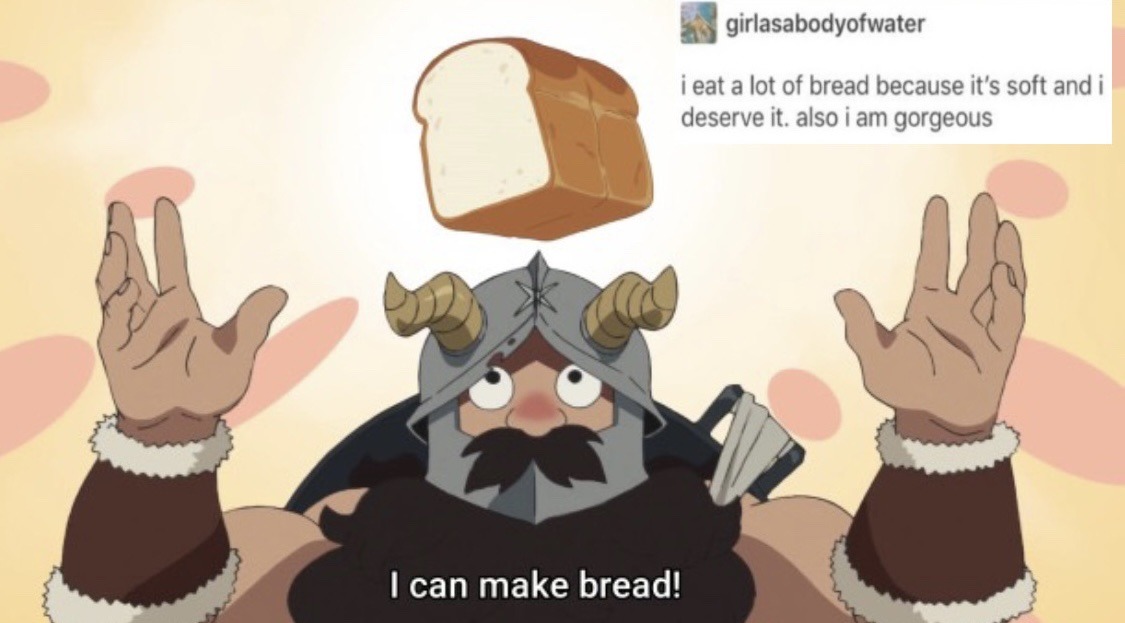
Luckily, they meet a hermit living in the dungeon — a hunter who carries a cooking pot as a shield, and whose dream is to cook up a dragon.
Every episode follows a pattern: a problem, a monster, a fight, and a meal. The routine is comforting even when the story gets heavy; after all, even when life is hard, you still need to make dinner every day. It’s both a fantasy adventure and a cozy cooking show that makes me crave a good meal shared with friends.
(Just be aware: despite the lighthearted tone that often teeters on childlike, the story contains some upsetting body horror, as well as bloody, deadly combat. I wouldn’t recommend it for little kids.)
the cast
It’s a huge ensemble story, and the characters are very much inspired by tabletop and video game RPG fantasy archetypes.

Laios: the tall-man fighter who’s somewhat the leader of the group. (“Tall-man” is what Tolkien or most TTRPG systems would name “human”, but in a choice I really like, in this story all sentient races — elves, dwarves, gnomes, oni etc. — are called “human”. Makes it easier to discuss humanity without limiting it to one look of person.)
He’s obsessed with monsters, so his special skill is picking up on any small element of a habitat or monster behavior.

Marcille: The party’s elven mage. Former school prodigy without a lot of practical experience, she’s a gigantic sloppy failure. I love her so much I’m working on a cosplay. She also just makes the best faces:

Chilchuck: A half-foot mercenary who’s the party’s safecracker. A half-foot is like a “halfling” or “Hobbit”, but instead of the jolly archetype, Chilchuck is incredibly world-weary for a number of good reasons. Older than he looks, and absolutely done with all this bullshit.

Senshi: The hunter dwarf who just wants to make sure everyone is fed. How long has he been living in the dungeon? Who knows, and it’ll be awhile before anyone asks…
In the English dub, he’s voiced perfectly by SungWon Cho (ProZD), who you might recognize from Dropout shows (or from his YouTube skits about Japanese RPG video games).
He’s the only character who is drawn with upskirt shots, by the way.

These are the main four party members at the beginning, but the story’s cast is huge, and many episodes/issues focus on other adventuring parties with their own problems. The treasure at the end of the dungeon is a wish granted by the dungeon itself, so you can imagine there are a lot of people eager to fight their way there to claim it. And deep inside the dungeon there’s one powerful mage driven mad by his own wish, who will stop at nothing to maintain control.
what’s it really about
Ecology. Conservation. Colonialism vs. cultural exchange. How are we all connected as living beings? How do the things we eat reflect on who we are and what we value? How do we honor and respect what has to die in order to keep ourselves alive? (Itadakimasu is a table blessing that’s clumsy to translate completely to English, often showing up as the table all saying together “let’s eat!” or “thanks for the food!” before eating, but the blessing also includes gratitude for everything that made that meal possible: farmers, cooks, the rain and the sun and the fertile ground, etc.)
And what out there is hungry for you? If you don’t have a natural predator, think abstractly. The ruling class’s hunger, the greed of the ultra-wealthy is famously insatiable. What about your own unfulfilled desire, or worse: a wish fulfilled that actually turned out terrible?
There’s also running themes of embracing the divergent ways that we each perceive the world. Multiple characters are coded as neurodivergent, particularly Laios and Falin being coded as autistic. (While Kui has said she didn’t intend for Laios to be autistic, folks on the spectrum are going to find a lot of Laios’s struggles with implied social situations very relatable. There’s a good video essay discussing the autistic coding, if you’d like more from someone who’s actually autistic.) But while awkward social situations are often a trigger for plot conflict —particularly the fight in episode 17 / book chapter 38, which I found uncomfortably close to how a dear friend broke up with me once — the story always handles it in a way that centers a person’s humanity. If a problem’s been impossible to solve, maybe this problem needs somebody who thinks really differently.
the books
I love Ryoko Kui’s worldbuilding, especially how it relates to character design. She’s published an entire book showing off her sketchbook designing for the series, and included pages of how she drew each person to look unique even within fantasy races.


She’s also just really good at unwinding a story. On rewatches I’m catching so much planting for things that paid off way later in a way I never would have expected.
And her timing is so good on her visual jokes. (Note to manga newcomers: Japanese is written right-to-left. Most comics when translated to English do not get mirrored (for art & layout reasons), so when reading manga you start on the right and read to the left.)

(PS: if you’ve never read a comic series that started out in another language, one of the bonuses you get is learning bits of another language’s onomatopoeia. it is fun to say out loud when you are reading. yes, instead of “clop” horse hooves could be “pakko poko” of course they can)
the animation
This one’s for everyone who watches anime in order to see lovingly-drawn food. Trigger actually hired a professional food designer.

But more than that: Studio Trigger is a perfect match for this material. Their founders worked on the stylized and strange Gainax action-adventure Gurren Lagaan, and Trigger’s become known for even more outlandish and weird productions like Kill La Kill (and man, I still really love that campy problematic mess). They have a reputation for being wild, expressive, and playful.
Dungeon Meshi‘s visual art is less abstract than other animations they’ve drawn, but that’s more true to the source material. But you can really see Trigger shining through during the combat.
I can’t really describe in text the way animation feels, so let me just show you three minutes of this water & magical effects animation, followed by an attack, the last few seconds stretching and skewing the characters in their desperation to escape:
One more thing to note is that there’s a lot left for Studio Trigger to draw! The final chapters of the books get weird and I can’t wait to see how they do the climax and ending.
in conclusion: thanks for the food
In an age when Netflix television shows written to be shallow and repetitive, because they expect you to be on your phone at the same time, Delicious in Dungeon rewards your attention with carefully drawn, fluid (and yes, often weird) animation, and a satisfying story with lots to say about community, food, and your place in the ecosystem.
And I need more people to talk about the ending with! So let me know if you decide to try it, or if you just feel like baking bread today.


Leave a Reply
You must be logged in to post a comment.