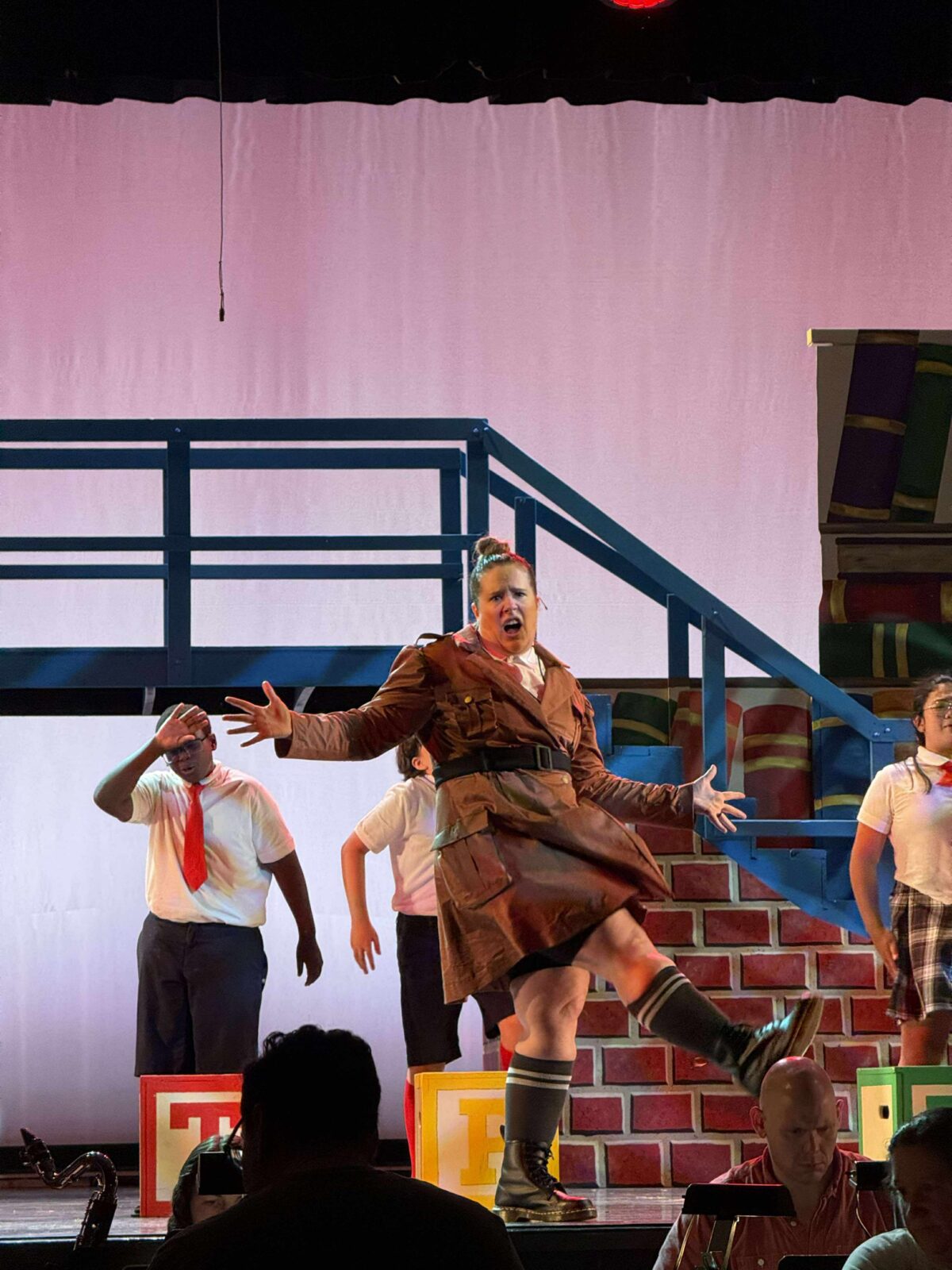
Part 1 was about Matilda and resistance, and part 2 will be a bit more personal, and most of it is about the role I’m playing.
I’m playing Miss Trunchbull, the sadistic headmistress of Matilda’s school and one of the big villains of the story. I can’t believe how much fun this role is, and furthermore I can’t believe they chose me to do it. It’s the most physically and vocally demanding part I’ve played since college. I’m doing…okay with it. I hear people say very kind things!
It’s also important to say: just 2 years ago, my body could not have done this. I had long COVID from August 2022 to August 2023. Because of that I was badly deconditioned; I could barely do the four stairs going up to the stage at this theater without gasping for air. And after all the work it took to rebuild my lungs and heart and legs (and spirit, from another year of isolation while everybody else wanted to believe the pandemic is over), in this musical I’m currently able to lead the most unhinged P.E. class, and sing the whole time. I tend towards self-deprecation, but I must leave grace for myself and first express gratitude that I recovered at all. Many others haven’t, and also a few of my dear friends are too at risk for COVID complications to be able to return to their 2019 activities. (If you know somebody in isolation due to disability, would you message them? When you’re stuck at home alone and every day is the same, it really matters to hear from somebody who cares.)
and all of that said…
my nemesis: broadway professional alternate universe carrie
…I can’t stop comparing myself to the person who never quit doing theatre, who didn’t take almost twenty years off to raise a child and hold down a respectable tech job.
It’s a long-term insecurity of mine going back to childhood. I wanted to be an actress and my family couldn’t afford the hobby. My entire life I’ve been seething in jealousy at the actress who I could have been if I hadn’t been born broke, at the teen who would have had grown more if our high school funded speech & theatre the way they funded football, at the woman who would have had more job opportunities out of college if she could sing and dance or afford child care, or for that matter avoid disability!
That’s a lot of excuses, say the TikTok grindset influencers. If you really wanted it, you would have made it happen. (But I don’t watch their content, so they can continue to howl whatever lies they think will earn them clicks.)
In the last post I mentioned that I got jealous of Matilda, a fictional character. And this hypothetical Broadway professional named Carrie that I’ve been seething at is just as fictional, and it’s not fair to me that I’m letting her take so much of my mental space! How would she have even come into being? I tried so hard and never could make it work. Even when I had that respectable tech job and so I could get back into community theatre, the late rehearsals left my body so exhausted that I couldn’t continue to do both.
In the US, making high-quality theatre isn’t for people with disabilities or those who need a day job to pay for their health care. It’s for able-bodied people who are independently wealthy. It’s a gig, and gig workers don’t get long-term health care or other benefits that make family life possible, like parental leave. The same is true in Hollywood as in Broadway. “Few jobs in the arts in general pay enough for people without generational wealth to survive,” wrote Kelsey McKinney in an excellent but depressing article for Defector three years ago, and it’s only gonna to get worse now, with federal grants for the arts triumphantly destroyed by a billionaire Nazi-saluting dipshit dancing around with a chainsaw.
I want to be good at acting, I want to be a stronger singer, I want to be good at directing, I want to be good at illuminating the nuances of the text so the whole cast can make the story glow on the stage. I’m so strongly motivated to create beautiful art and be in community with others who love doing the same. It’s not fair that you need to be born into privilege or independently wealthy to get to do professional theatre, or even to go see it done. I want a world where everyone is free to make and enjoy whatever art they choose.
🍰
I also wonder what I would be like if I weren’t so much like Miss Honey. Like Jenny, early and consistent experiences at the hands of authority figures have led me to want to freeze or fawn whenever I’m challenged, and while I’m better at breaking out of that these days, it’s still a huge hurdle. Sometimes I look at writers, artists, or performers I admire and think, what’s it like to have confidence? What’s it like to be someone who identifies as a “winner”?
In this world, children, there are two types of human being. The winners and the losers. I am a winner. I play by the rules and I win. But if I play by the rules and I… do not win, then something is wrong, something is not working. And when something is wrong you have to put it right. Even if it screams.
– Trunchbull, MATILDA
Playing Trunchbull, I’m exploring one side of that identity, and the rush that comes from self-confidence is very fun to play. But her superiority comes from putting down those who are smaller, from bullying targets who cannot match her strength. That’s a terrible path, but I sure would love to find a balanced, kinder, healthy place where I didn’t automatically think of myself as the loser.
🍰
the trunchbull trauma
One notable thing about playing Trunchbull is that people come up to you and tell you stories of the worst teacher they’ve ever had.
Trunchbull is a villain you understand because you have been in her classroom, you’ve sat in her detention hall. Maybe she didn’t throw you across the room by your hair, but from all the stories I’m hearing it seems very common that a teacher like Trunchbull stabbed you with a psychic knife that chipped and left shrapnel in your soul, and it aches every time you think you didn’t do well enough.
Most teachers I know got into the profession because they wanted to help children to grow into well-rounded, curious, clever adults. But oh boy, the ones who got into it because they just wanted power…
My lipstick and eyebrows are painted in shapes that remind me of a grade school teacher (who was unfriendly to me but simply atrocious to my younger sibling). The haughty stare with a raised eyebrow is copying the teacher who once took recess from the entire class because I couldn’t sit quietly, and then made my classmates all stand up and shame me for it.
(We’re not talking about my dad today! But in his 7th grade P.E. class — where my noodly arms that were only fit to write code or poetry on an Apple IIe had absolutely no shot at climbing a rope, no matter how loudly he yelled at me to just do it — he called for the class’s attention with two sharp toots on a whistle: one short, one long. My Trunchbull is borrowing those toots, thanks Dad!)
I add something to her every time I hear someone else’s stories. The magic of theatre means that we can create walking effigies of all those who’ve wronged our community, a cleansing ritual that can heal the phantom pains that afflict us all.
🍰
the villainess who looks like a man
I really hate the trope where a female villain is extra gross because she looks like a man.
But Roald Dahl was a blunt writer who made unambiguous, ugly villains, and this trope is easy to use. It’s in Matilda, it’s in the aunts painted like drag caricatures in James and the Giant Peach, it’s in the bald heads of The Witches (where it’s rolled into some super antisemitic conspiracy theory garbage too). JK Rowling, arguably the inheritor of Roald Dahl’s title of Revenge Narratives For Kids, used mannish villainesses heavily in Harry Potter too. And I hate it, because (like JK Rowling’s new role these days as the self-appointed bouncer at the Club Womanhood): this trope is used in real life to control the appearance of women, excluding and even vilifying those who do not conform, especially trans women and women of color.
Trunchbull in the musical is written for a man in drag; the music is written in a tenor range. Sure, men are often taller than women and so you’re more likely to get a significant size difference with whoever’s playing the little kids. But it doesn’t sit right with me when the audience takes away from this that “the joke is she is actually a man”. (Note: I have less of an objection to drag performers because drag performers often really admire femininity! Their depictions are still highly exaggerated and sometimes clownish, but I personally don’t feel disrespected by them. Some of my trans women friends disagree about that, and I certainly respect their perspective too.)
As part of my dramaturgical research I look at some reviews of productions, to get a feel for how critics have responded to the play. I’m picking on one old review of a female actress playing Trunchbull, from a St. Louis public radio station: “A woman in the role is at a disadvantage: she just doesn’t seem quite so silly – or so threatening.”
And like: that’s not true at all. If you don’t think women are capable of being threatening while also being absurd, take another look at how some (usually white) women leverage their perceived delicacy to get a rush of power through oppressing others. While I was doing character analysis research, I found references to an academic essay comparing Trunchbull to Margaret Thatcher, and I get it. Thatcher’s one of the ones whose policies of “cruelty, but make it prim and polite” paved the way to where we’re standing right now, where perfectly preened sneering fashion dolls spew racist hatred on behalf of the White House every night in broadcast news. I hate those boot-sucking DHS TV spots that ABC plays every night during the news, thanking the president for his bloodthirstiness. Fascism attracts people through a carefully manicured aesthetic that lull people into supporting atrocities. It looks like this.

In Matilda, Miss Trunchbull’s punishments were so extreme specifically because she knew the tales would sound ridiculous when told to a parent. “They would never believe she was capable of murder,” says Miss Honey. Look at the tales we’re hearing now about the horrifying conditions in the concentration camps in Florida and in El Salvador, and yet news organizations are timid and hedge wildly while describing the first-hand reports, because they worry that printing such shocking stories could lead to a libel suit directly from the White House. Basically: Agatha Trunchbull and Kristi Noem are the same. They are both cold-blooded, sadistic killers who rely on their appearance to deflect accusations.
[…Now I have to put some transition here to get from American concentration camps back to how much fun it is to do community theatre. sigh. 2025.]
Anyway, I’m a woman and I’m playing Trunchbull and I don’t have to look like a man while I do it. Our production is double-cast and we’re both women, and we’re doing just fine. (As a low alto (D#3-Ab5) often pinched to help fill out a sparse tenor section, I’m singing the tenor vocals mostly as-written, speaking what’s too low and taking most of “The Hammer” up an octave. The other Trunchbull is a soprano and she’s mostly singing it all up.)
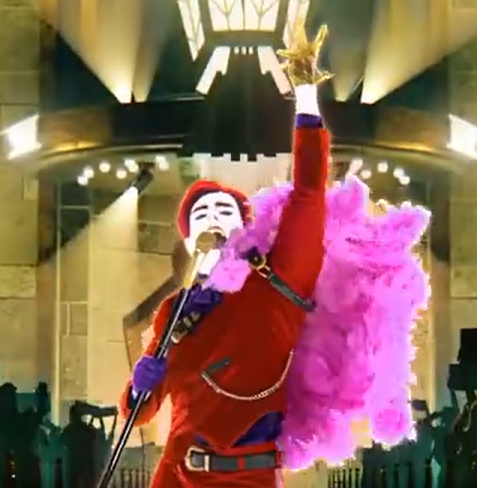
If I’m at a disadvantage on anything, it’s from lacking the full-body confidence that comes from time spent performing burlesque. I’m thinking a lot of Pat Carroll’s Ursula in The Little Mermaid, herself based on John Waters’s favorite drag performer Divine (a.k.a. Edna Turnblad in Hairspray (1988)). Emma Thompson’s Trunchbull for the Netflix movie version of the musical was early reassurance that it’s certainly okay for the role to be played by a woman (though I do wish they hadn’t gone with the fat suit). Also I found a video of Mason Alexander Park (Desire from Netflix’s Sandman, and the non-binary tech prodigy in the Quantum Leap revival) singing “Smell of Rebellion” which helped me to find the glee and also glamour in that song. Also this is a pull but: have you watched the video for Annie Lennox’s “No More I Love Yous” lately? (Imagine how I once thought I was straight and still replayed that weird, weird video!) I’m trying to pull from her voice and also her exaggerated facial expressions during that weird horsey dream break.
So: it’s camp. I’m all on board for camp.

[Photo: screenshot from the music video]
🍰
putting the look together
I really like Quentin Blake’s illustrations from the original book. They’re so playful and dynamic and expressive! Here’s Trunchbull throwing Amanda Thripp. I printed out a bunch of these drawings to make the cover for my script, and I hoped to pull in elements that would remind me of how fun these illustrations are. (Never did find a way to get that sickly green in there, but I’m at peace with it.)
The costume I sewed myself from a pattern for a wrap dress with military flair like epaulets and cargo pockets. The other Trunchbull actress designed an extra-puffy sleeve for it, so we can give her a silhouette that emphasizes her strong arms and shoulders.


I went into the makeup design looking at some examples of how others have done it, and unfortunately, they’re all ugly mannish brutes. My counterpart is going this direction too, drawing herself more moles and hair. While, yes like I said, that’s supported by the text, I wanted to see if I could play around with other interpretations on the character.
First off, one of my strong points as an actress is I have a very expressive face, and so I can trust that I’ll communicate severity and cruelty first just by acting and reacting.
Trunchbull is an athlete, so I’m playing up athletic features such as a strong jawline. While I am more physically active now than I’ve been in a very long time, I…do not look like an athlete. But I also think that’s a core fear that Trunchbull has, the slipping away of her identity and what made her special. In “The Hammer”, she sings “Did I let myself go?” followed by at least 5 “no”s depending on the performer (it’s an ad lib measure). You could read that as staunchly firm, but in the Netflix adaptation of the musical I like Emma Thompson’s choice to have the lady protesting a bit too much: mortified by the shape she’s in, and stuck in her past back when she received attention and awards.
But if you really want to go for text, the makeup design I drew leans on the original Quentin Blake illustrations and on Dahl’s description of “obstinate chin, a cruel mouth and small arrogant eyes”. I agree that 40 or 50 years of intense arrogance and spite would show on her face and so I’m emphasizing the brow and mouth wrinkles that would result from all that rage and scowling.

Trunchbull is unmarried – she chose her career instead of motherhood – and has some weird lines in the book that sound like Dahl’s trying to mock the talking points of a second-wave radical feminist. (Aside: if it were 2025, Trunchbull absolutely would be a TERF pickling her brains in the same toxic swamp as JK Rowling, believing to the end that everyone was only mad at her because she’s too good at winning.)
It’s that radfem tone that’s leading me to being fine leaving out many feminine signifiers that usually make me personally feel comfortable: specifically brow plucking and nail polish. I highly doubt Agatha Trunchbull would bother with sculpting her brows pretty to please the male gaze. And when she’s terrorizing children, she’d probably just chip that manicure!
Anyway despite all those words and the care I’m taking to avoid stereotypes that can be harmful, it’s very interesting how I end up looking mannish anyway: because of my shape, because of my character’s brutality, because I’m using makeup to emphasize the squareness of my jaw, because I’ve omitted most feminine signifiers. After all: it’s still so easy to perceive masculinity as the default. Take off the bows and Ms. Pac-Man and Minnie Mouse look like men.
🍰
Why have I written so many words about MATILDA and playing this part? Maybe it’ll help somebody else who is preparing this role, or another dramaturg doing research for the production. But mostly, I just wanted to sit down and babble about the work again, because it has been too long since I’ve written about my thought process when analyzing a show and a character.
If you’re in Northwest suburban Chicagoland and want to come see the show, tickets are still available! The remaining shows I’m on are the 18th at 7pm, and the 20th at 2pm.

Leave a Reply
You must be logged in to post a comment.