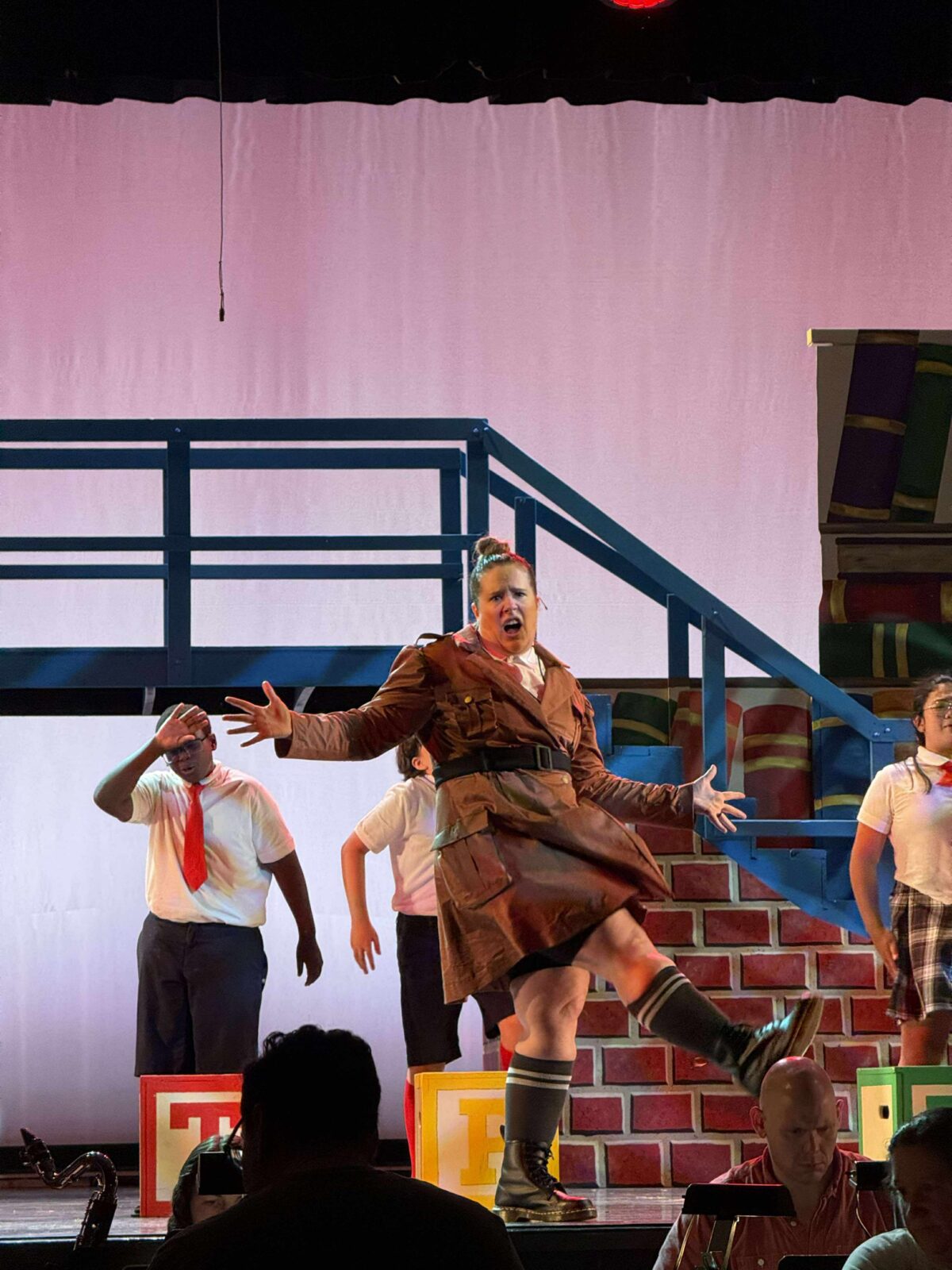
2025 is an interesting year to be doing the musical MATILDA.
I guess though, that 2025 is an interesting time to try and do anything at all that isn’t screaming, or staying frozen in horror. That’s what I did between last November and January of this year, freezing everything but the thumb required to operate my horror portal, keeping my eyes filled with fresh dread and doom.

But you have to live. You have to survive, to outlive them, to dance on their graves.
So I’m glad for community theater, and I’m nervous about having nothing outside of the house to do after July. (If you’re in NW Chicagoland casting silly but hardworking altos in their 40s, or if you’re looking for a research-motivated dramaturgy nerd to fill out your production table, hit me up?)
I was really struck by the need to blog about this show, and ended up with a pile of disconnected bullet points floating around in the word processor here. I’ve done my best to sort them into two different blog posts. The first is some loose thoughts on what Matilda is saying about resistance, the second will be more of a personal reflection, with a lot about preparing to play Trunchbull.
🍰
on finally reading the book
When I was a kid, I was so much like Matilda. People around me found me off-putting, weird, and a know-it-all, but mostly: I learned how to read very early (2 and a half) and I would read everything I could grab, even stuff that was way too old for a little kid to be reading. By age 10, I was reading adult books (and asking questions that made everybody uncomfortable).
Around the same time as I started picking adult books off the shelves, our school library got the new Roald Dahl book, Matilda. I thought I was pretty special for reading novels at age 10, but Matilda was reading novels at age 5. I read that on the back cover, thought, “oh, this girl thinks she’s better than me?! Well! I didn’t really like reading Charlie and the Chocolate Factory anyway…” and passed on it.
(I’m aware that I was being unreasonably jealous of a fictional character. That’s foreshadowing for the next post.)
So I didn’t actually read Matilda until this year. I heard that this was the play selected by the theatre company we usually hang with for the summer, and so I crammed it on the train on my way back from a protest. To my surprise, it fit remarkably well with the reason I was downtown protesting to begin with.
🍰
“you gotta put it right”
But nobody else is going to put it right for me,
Nobody but me is gonna change my story
Sometimes you have to be a little bit naughty.
– Matilda, “Naughty”
In 2018, to celebrate 30 years of the book, new statues were unveiled at the Roald Dahl Museum in Buckinghamshire, England. Two statues: Matilda, and the bully they wish she could stand up to:

It’s really attractive to think that somebody small can change the course of history. Matilda (the book, the movie, the musical) celebrates our agency, even if we’re nobodies.
So when do I personally develop telekinesis already? How come none of us have manifested an end to worldwide persecution, warring, or genocide? Have I, personally, just not wanted it badly enough?
It’s fiction, but there’s still a nugget of truth: real life resistance always is strongest when people are clever enough to wield their power in a creative way. I’m inspired by the community responses to the ICE invasion in Los Angeles, and by the stories I’m hearing around the United States of neighborhoods coming together to protect their neighbors from being kidnapped by ICE, and despite all the militarization and bravado, you see time and again these neo-Gestapo brownshirts backing off, tail between their camo cargo-panted legs.
But effective resistance can also take forms other than placing your bodies on the line. You might have seen this Oscar-nominated short from the National Film Board of Canada: “My Grandmother Ironed the King’s Shirts” (1999), where Nazi soldiers invading Norway had their uniforms sabotaged by a bunch of ordinary laundry ladies.
It only took one person $8 to impersonate Eli Lilly on Twitter when Blue was first released, calling attention to the company’s unconscionable greedy price-gouging on insulin, and resulting in enough of a backlash that the company responded by capping the price to a more affordable $35 a month.
I’ve also been listening to the lefty history podcast “Cool People Who Did Cool Stuff” to hear stories of creative, effective resistance from across history. (Like the hippie theater collective Bread & Puppet? I just learned about them this week on that show. Effective, cheap protest art that gets attention, feeds people, and builds community. I want to learn so much more about protest art and protest theatre specifically…)
Matilda wasn’t going to beat the Trunchbull in single combat, but she came up with an effective plan to scare her off. (And it’s important to note that she might have found ways to scare her using more mundane, non-telekinesis methods too, especially if she had help from others with different skills.) It’s crucial to know what your powers are, and then wield them creatively and bravely.
It might not be easy, but neither is it optional. Act Two starts with “When I Grow Up”, a song wistfully picturing a perfect future without the oppression children face (mostly it’s relatable indignities like: going to bed at a reasonable hour, or not being able to watch enough cartoons). At the end of the song, Miss Honey sings a mournful solo, cursing her own meekness and inability to protect her students from predators:
when I grow up
I will be brave enough to fight the creatures
that you have to fight beneath your bed each night
to be a grown-up
Matilda counters, reprising her first song “Naughty”, that we have to act in the present if we want a better future to happen. Even if you are small, even if you aren’t a billionaire or a Supreme Court justice or elected official, the minute you think you’re powerless you’re as good as complicit.
Just because you find that life’s not fair, it
doesn’t mean that you just have to grin and bear it
If you always take it on the chin and wear it
nothing will change.
If I think the ending is fixed already
I might as well be saying I think that it’s okay, and
that’s not right!
MATILDA is a musical about rebellion so strong the bullies can smell it. She sees how her unique skills can affect the story, and then she acts. She doesn’t end fascism worldwide, but she manages to rescue both her class and her teacher from a terrible bully, and you can’t convince me that doesn’t matter. It brings me hope that there’s always a way to fight back.

Sunday afternoon, before the matinee, I did a little pump-up speech based on all this in the warm-up room. It wrapped up with this:
Now, we don’t have telekinesis. But: today each and every one of us is here, because we do have powers.
We have the power of storytelling. We can use our voices and our bodies (and our organization skills) to help an audience experience a new perspective. Not everybody has the power to make people empathize with a stranger, but we do!
We have the power of a strong community that takes care of each other. I’m so proud to be a part of what we’ve all created here this summer. We have the power of teamwork.
When we work together, when we’re locked in and performing and listening to and helping each other, our ordinary powers become a super power.
Whether or not that’s just fiction, or platitudes, (or “cope” as the chronically online call it), you cannot escape doom without hope. Hope is a precursor to courage. I’d rather have that than staying frozen at the horror portal any day.
🍰
Leave a Reply
You must be logged in to post a comment.